Can a Lock Make or Break a Knife? We Dive Into the Mechanisms That Matter.
Episode 030 — Lock Mechanisms

Can a Lock Make or Break a Knife? We Dive Into the Lock Mechanisms That Matter.
In this episode of EDC‑TV, Grant, Abe, and Inky sit down to talk about one of the most overlooked but absolutely critical parts of any folding knife: the lock mechanism. Before diving into the engineering, the crew kicks things off with new gear, steel talk, and a few classic stories from decades in the knife world.
Whether you’re into Swiss Army knives, multitools, tactical folders, or custom blades, this episode breaks down the lock types you’ve used for years — and the ones you’ve probably never heard of.
New Gear This Week
Before getting into lock mechanisms, the guys compare some new lights and blades that landed on their benches.
🔦 Abe’s New Lights
Abe picked up a couple of ThruNite models after comparing them to the Wubin lights the crew has talked about before. The big takeaway:
- The ThruNite has a simpler, more intuitive interface
- The magnet is significantly stronger than the Wubin
- One model had a plastic frame that felt disappointing compared to the metal-bodied version
Grant even tested his Wubin while replacing a faucet — and the magnet failed to hold under a sink. Abe’s ThruNite? Rock solid.
🔪 Inky’s Cold Steel Haul
Inky grabbed a Trailmaster and a Natchez Bowie on deep discount. Both in 4034 steel — not “super steel,” but perfectly fine for what they are.
He calls them “catch and release” knives: beautiful, classic, and probably not destined for heavy use.
🔪 Grant’s Search for a New Voyager
After nearly taking the tip of his finger off with his old Cold Steel Voyager, Grant is hunting for a replacement. If you see a deal, send it his way.
Steel Talk: 4034, 3V, ATS‑34, 154CM, D2, and More
Knife nerds, rejoice — this episode goes deep.
The crew compares:
- 4034 — budget-friendly, German origin, perfectly serviceable
- CPM 3V — Cold Steel’s premium option
- ATS‑34 vs 154CM vs RWL‑34 — same family, different origins
- D2 — beloved by some, overhyped by others
Abe shares insights from actually making knives from these steels, including how small differences in carbon content can change corrosion resistance.
The Dozier Segment
This episode includes a fantastic deep dive into Bob Dozier, his grinding skill, his hollow‑ground blades, and the makers who followed in his footsteps.
Highlights include:
- Dozier’s ability to hollow‑grind a blade freehand in 20 minutes
- His early work with A.G. Russell
- The makers influenced by him (Charlie May, Crane, and others)
- The legendary Crossada and Canoe Knife
- Stories from Blade Show and SHOT Show
- The “Texas barbecue set” knife culture
- Why handle length matters more than most people realize
This segment alone is worth the episode.
Lock Mechanisms Explained
After the gear and steel talk, the crew finally dives into the main topic: lock mechanisms on folding knives, multitools, and Swiss Army Knives.
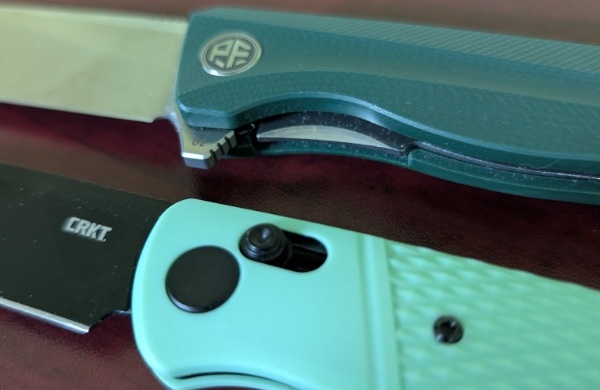
Grant kicks things off with a personal story involving a CRKT folding Razel — a knife he gifted to his father years ago. It uses:
- With standard liner lock mechanisms
- Secondary safety lock mechanisms(CRKT’s old “LAWKS” system)
This leads into a breakdown of the most common lock mechanisms:
🔒 Liner Lock Mechanisms
Simple, reliable, and found on countless tactical folders.
🔒 Frame Lock Mechanisms
Stronger than a liner lock and uses the handle itself as the lock bar.
🔒 Back Lock / Lockback Mechanisms
Classic, secure, and common on traditional knives.
🔒 Slipjoint
No lock mechanisms, tension‑based. Common on Swiss Army knives.
🔒 Compression Lock
Spyderco’s signature: strong, safe, and fidget‑friendly.
🔒 Axis‑Style Locks
Ambidextrous, smooth, and widely copied.
🔒 Secondary Locks
Like the one on Grant’s CRKT Razel — designed to prevent accidental disengagement.
The crew discusses the pros, cons, and real‑world performance of each type, including which ones they trust and which ones they avoid.
Key Takeaways
- A knife’s lock is just as important as its steel or blade shape
- Budget lights and knives can still surprise you
- Steel snobbery is overrated — performance matters more than labels
- Dozier’s influence on modern knife making is massive
- Not all magnets are created equal
- Lock mechanisms affect safety, usability, and longevity
Join the Discussion
Want to talk about lock mechanisms, steels, or your favorite folding knife?
Join the community: